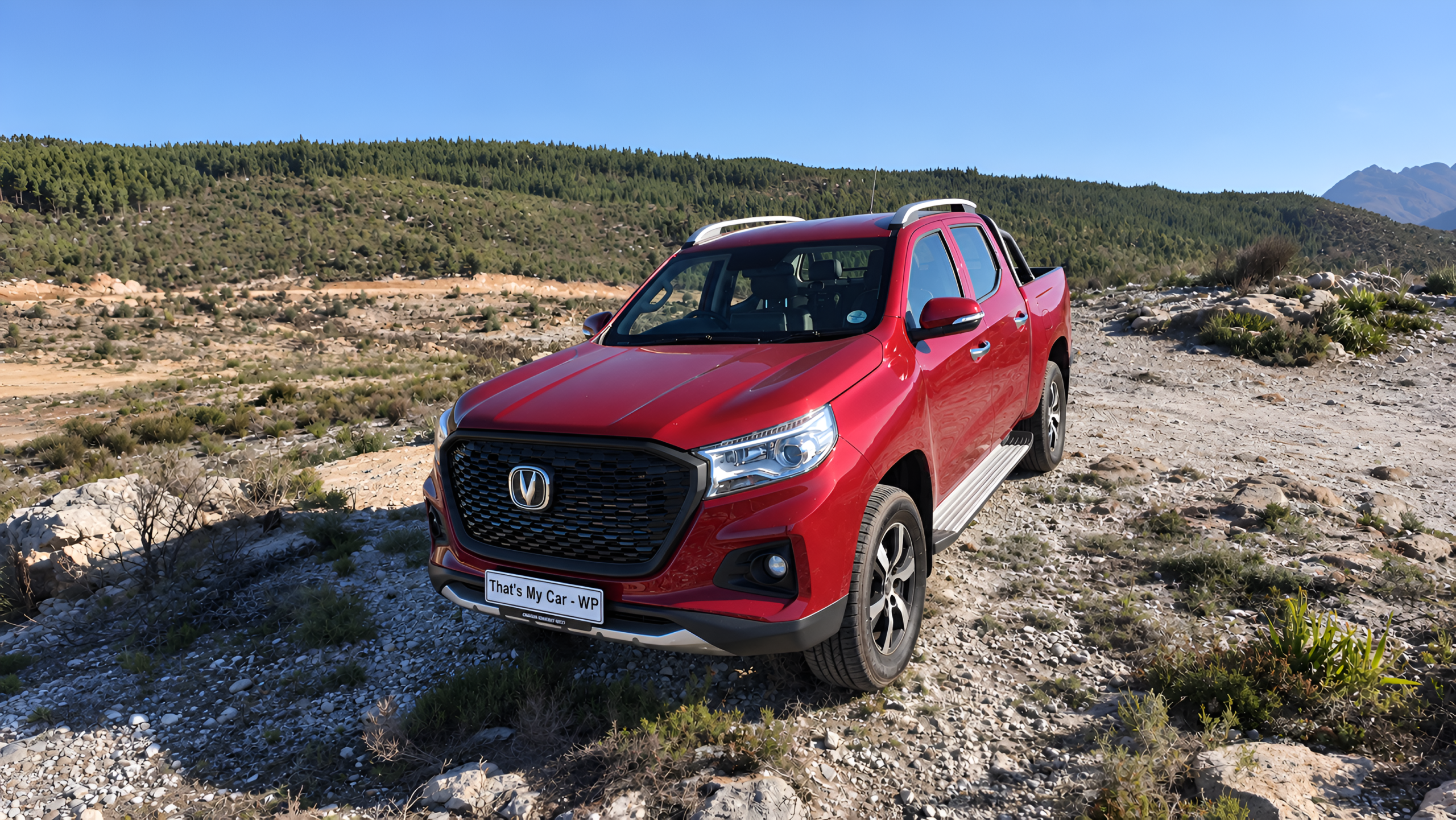
2026 Changan Hunter Diesel
The South African bakkie segment is a brutal, brand-loyal battleground where legacy badges have historically enjoyed unchallenged dominance. Decades of ingrained consumer habits dictate that breaking into this space requires either monumental heritage or an undeniable price advantage. Yet, a new wave of Chinese contenders is rapidly reshaping the landscape. Amidst this tectonic shift arrives the Changan Hunter – a double-cab demanding attention not with a multi-decade legacy, but with an aggressively sharp value proposition.
For those analyzing a global Changan Hunter pickup review, the intrigue often lies in its shared Stellantis architecture. However, for the local buyer navigating skyrocketing vehicle costs, the primary question is much simpler: does the Changan Hunter Diesel actually present a solid case for itself in South Africa?
The Anatomy of a Challenger
Beneath its highly modern, chiselled sheet metal, the Hunter is not an entirely bespoke creation. Global market analysts frequently research the Changan Hunter vs Peugeot Landtrek differences, but in truth, the two vehicles are remarkably similar beneath the skin. By relying heavily on the proven Peugeot Landtrek platform, this Chinese pickup truck utilizes a traditional, robust formula that bypasses the growing pains often associated with ground-up, emerging-market vehicle architectures.
Diving into the Changan Hunter 1.9 turbodiesel specs, the vehicle – badged locally as a 2.0-litre but actually displacing a slightly smaller 1.9 litres – delivers a steady 110 kW of power and 350 Nm of torque. Mated to a 6-speed automatic transmission in the flagship CE 4×4 trim, its performance figures place it squarely against emerging rivals. But where the vehicle truly weaponises its positioning is at the dealership window. If you are looking for the Best 4×4 double cab automatic under R600 000, the Hunter emerges as the definitive, data-backed answer.
The Changan Hunter bakkie price currently spans from R449 900 for the entry-level 2WD manual up to R569 900 for the top-tier 4WD automatic. Landing precisely at this sub-R570,000 threshold makes it the cheapest double cab automatic offering four-wheel drive in the local market by a substantial margin, undercutting legacy rivals by well over R100 000. Naturally, this financial leverage forces an immediate Changan vs GWM P-Series cross-shop for fleet buyers and budget-conscious private owners alike.
Where It Thrives: Dirt and Daily Utility
The Hunter’s strongest arguments are forged far off the tarmac. The CE 4×4 derivative utilizes a part-time four-wheel-drive system complete with low-range gearing, a rear differential lock, and a respectable 226 mm of ground clearance. But numbers on a brochure do not tell the whole story. What about the Changan Hunter 1.9 diesel real-world off-road performance? Evaluators and testing regimes report that it is a highly capable machine on rocky terrain, exhibiting excellent perceived build quality and structural rigidity. It confidently dismisses lingering doubts regarding Chinese truck reliability, remaining rattle-free under duress while the ladder-frame chassis absorbs punishing trail articulation with surprising grace.
Internally, the cabin punches significantly above its price bracket. Any comprehensive Changan Hunter 4×4 review SA must emphasize its standard interior appointments. Securing leather upholstery, electrically adjustable front seats, a 10-inch infotainment touchscreen, and a comprehensive safety suite featuring six airbags, ABS, and electronic stability control at this price point is objectively impressive.
The Critical Compromises
However, no vehicle at this price point escapes without concessions. What are the common compromises of the Changan Hunter bakkie? The data reveals distinct operational limitations. First, the 1.9-litre powerplant provides adequate low-speed grunt for trail driving, but it notably runs out of breath at national highway speeds. Overtaking maneuvers at 120 km/h require careful calculation, and independent testing clocks its 0-100 km/h sprint at 13 seconds.
Second, its 2,000 kg braked towing capacity falls noticeably short of the 3 000 kg to 3 500 kg segment standard. Finally, on the technological front, the standard infotainment setup surprisingly omits Apple CarPlay and Android Auto integration – a strange and glaring oversight for a modern cabin in a digitally connected era.
The Final Verdict
This invariably leads to the most common consumer query: Is the Changan Hunter better than the GWM P-Series? The answer is highly nuanced. The GWM offers more sheer dimensional footprint and superior digital integration, while the Hunter presents a sharply packaged, dynamically balanced alternative with an unbeatable price-to-capability ratio.
Does the Changan Hunter Diesel make a solid case for itself? Yes, provided the buyer understands exactly what they are purchasing. It is not designed to be a high-speed highway cruiser or a heavy-duty towing rig. Instead, it is a mechanically robust, highly capable off-roader that offers unprecedented financial accessibility and a surprisingly good cabin – minus Apple CarPlay and Android Auto. In all, the Hunter is a competitive, logical choice.

