
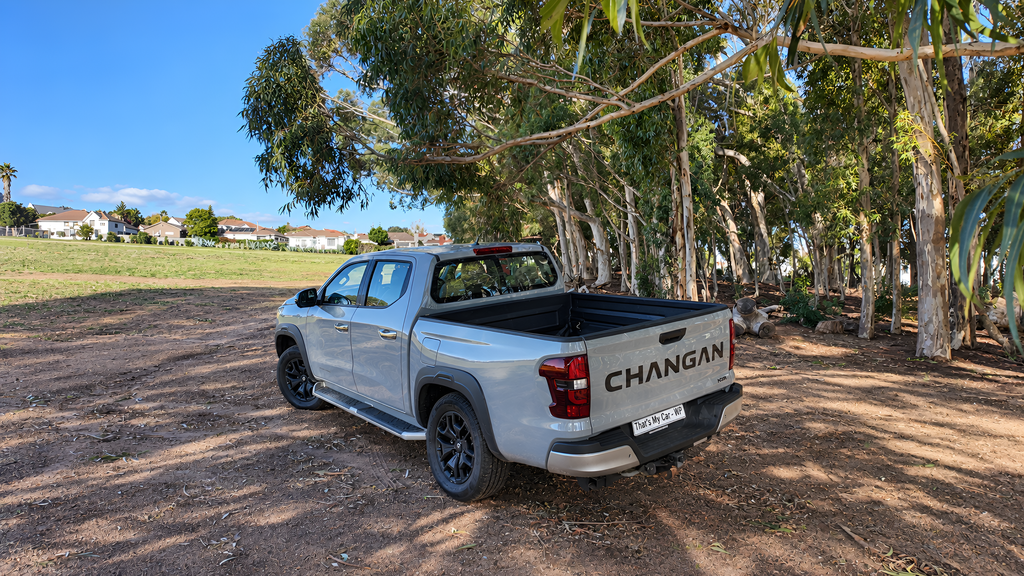
2026 Changan Hunter REEV K50
About a year ago, a fully electric vehicle delivered a stark lesson in the realities of local grid infrastructure. In hindsight, the resulting trauma was partly my fault – I simply didn’t understand the logistical algorithms and meticulous route planning required for pure EV driving.
The phenomenon of EV range anxiety South Africa is not a myth; it is a quantifiable psychological barrier, and it stuck with me. Fast forward to very recently, and the automotive landscape shifted. I collected the vehicle for a Changan Hunter REEV review, picking up the bakkie on a Friday evening in Somerset West with an 89% state of charge.
To be brutally honest, my anxiety metrics were just as high as the battery level. My initial expectations were deeply sceptical, especially after struggling with the power-up sequence, only to realise the bakkie switches on the moment you unlock it. And when you’re seated, simply hit the brakes and flick the right stalk on the steering column into drive. The systemic issue wasn’t the engineering; it was my own delayed adaptation to the operational mechanics of modern plug-in hybrid pickup trucks.
The Real-World Application
Saturday fundamentally reconfigured my data set. We embarked on a proper family operational test – my son had an open day at school, requiring me to navigate the Cape Boland in EV range under terrible weather conditions. Inside the cabin, however, the environment was highly controlled: smooth, acoustically insulated, and remarkably stress-free. This became a comprehensive real-world hybrid bakkie test.
What immediately dominated the telemetry was the sheer capacity. The vehicle projected a verified 890km hybrid range when I took delivery, a staggering combined metric from both the electric motor and the internal combustion engine.
Throughout the day, the itinerary included:
- Multiple routing cycles from Klapmuts to Stellenbosch (including two complete round-trip).
- A secondary run out to Paarl.
- Intermittent urban shopping cycles.
And then, a critical psychological shift occurred: the anxiety simply vanished. Many consumers researching the market ask how to overcome EV range anxiety; the empirical answer lies in dual-powertrain redundancy. The seamless integration of an electric primary drive with a robust petrol backup for electric vehicles eliminates the need for predictive grid calculations. No overthinking. No stress. You just drive.
The System Architecture
For those analysing the technical data and asking, is a plug-in hybrid better than an EV, Sunday morning provided the conclusive metric. On the return leg to Somerset West, passing through the Stellenbosch corridor, the battery telemetry dropped to a 15% state of charge, indicating approximately 15 km of localised EV range remaining.
Was I worried about what happens when an EV battery dies? Not mathematically possible. Sitting right beneath the chassis was over 600 km of internal combustion range ready to deploy. This illustrates the critical technical distinction in the REEV vs PHEV debate – the range-extended electric vehicle framework uses the petrol engine primarily as a generator, maintaining the instant torque and smooth dynamics of electric driving without the terminal failure point of a depleted battery. That is the operational difference.
Infrastructure and Telemetry
I isolated a high-output terminal among the fast charging stations Somerset West currently offers at the local mall, initiated the handshake protocol, plugged in, and executed my errands. Returning precisely 29 minutes later, I was greeted by my editor-in-chief, wearing a classic “I told you so” expression. The telemetry confirmed the Changan Hunter charging time claims: the battery had spiked back to a 79% charge state.
Aggregated Data Matrix: Changan Hunter Specs
- Electric + Petrol Combined Range: ±1 000 km (Changan Hunter real world range verified).
- Fast Charging Cycle: ~30 minutes (to ~80%).
- Powertrain Architecture: EV driving with internal combustion backup.
- Cabin Dynamics: Smooth, acoustically insulated, highly comfortable.
- Fail-Safe Capacity: ±800+ km of reserve petrol range when necessary.
Final Analytical Output
This hardware did not merely impress me; it forcibly restructured my automotive perspective. The Changan Hunter REEV South Africa configuration acts as the definitive bridge between the theoretical appeal of electric driving and the harsh realities of our local logistics.
Is this the best hybrid bakkie 2026 has to offer? There is still plenty of water to run under the bridge before we can call it, but the data strongly suggests that it gets more things right than wrong. As the market for hybrid bakkies South Africa expands, this vehicle proves that you no longer need to sacrifice operational freedom for efficiency. No more range anxiety, no more obsessive route planning – just unrestricted mobility. If this weekend’s test generated one undeniable conclusion, it is this: the plug-in hybrid architecture patched my EV trauma.

