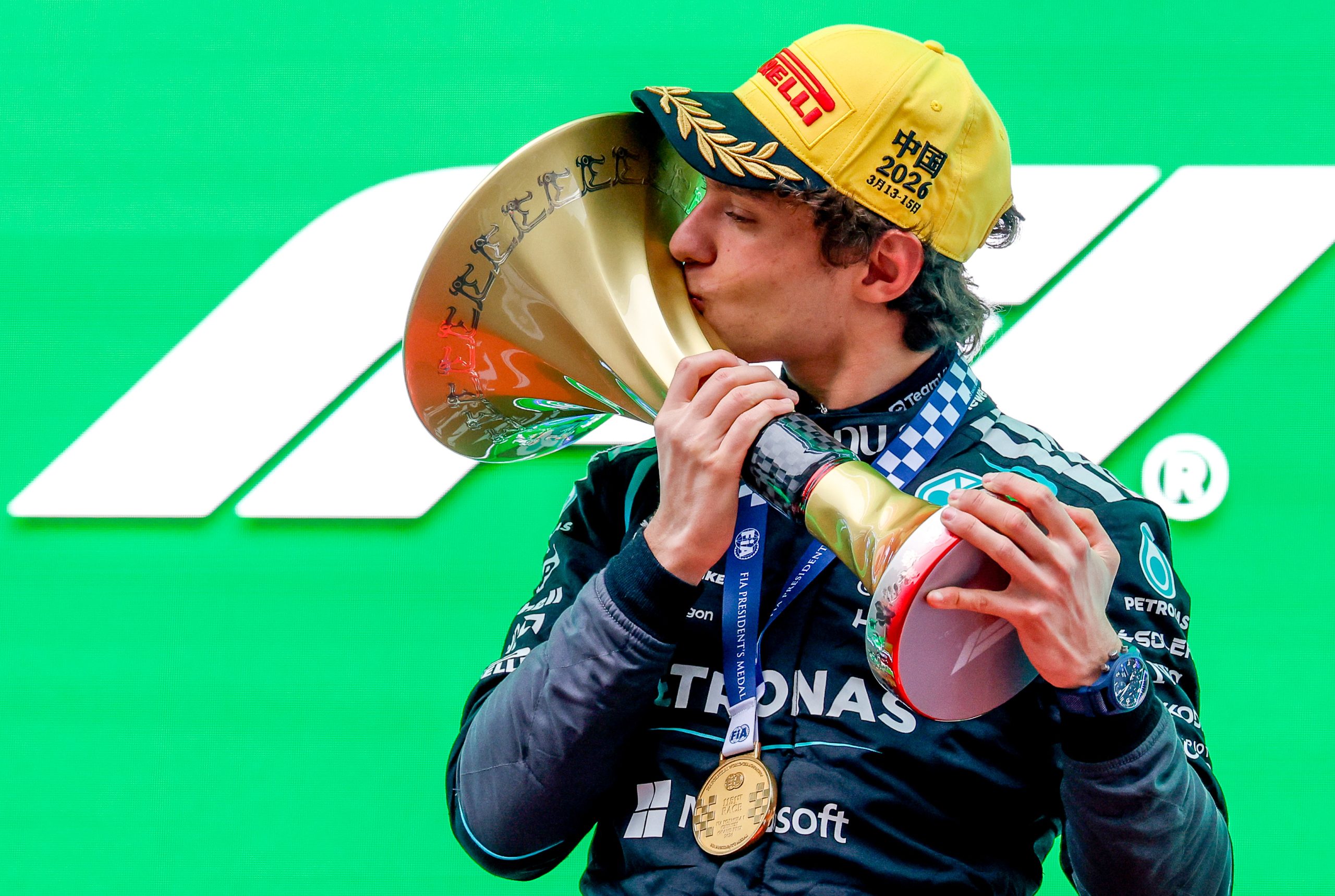
Kimi Antonelli. Image: Mercedes-AMG F1
Formula 1 remains a ruthless proving ground, but youth increasingly dictates the pace of the modern grid. Following Kimi Antonelli’s historic 2026 Chinese Grand Prix victory, the statistical benchmark for precocious motorsport talent has shifted decisively. For South African motorsport fans dissecting the latest F1 data and racing metrics, here is the definitive, descending ranking of the top ten youngest F1 race winners in Formula One history.
Kimi Räikkönen: 23 years, 5 months, 6 days (Malaysia 2003)
The “Iceman” stamped his authority at Sepang, securing his maiden Formula 1 victory for McLaren with clinical precision. Capitalising on a chaotic race start, Räikkönen dominated the sweltering Malaysian Grand Prix heat. His unmatched pace and tactical tyre management proved to the paddock that he possessed the cold, hard metrics required to be a future F1 World Champion.
Oscar Piastri: 23 years, 3 months, 15 days (Hungary 2024)
Piastri’s breakthrough F1 win at the Hungaroring was a masterclass in composed, high-pressure execution. Despite severe McLaren team-order drama and intense pressure from Lando Norris, the Australian held his nerve. Operating with metronomic consistency, he secured a hard-fought Hungarian Grand Prix victory that cemented his status as a generational, data-verified talent on the Formula 1 grid.
Lewis Hamilton: 22 years, 5 months, 3 days (Canada 2007)
Hamilton’s maiden Formula One triumph in Montreal was a flawless execution of raw speed. Surviving multiple Safety Car restarts and severe tyre degradation, the rookie drove his McLaren like a seasoned veteran. It was an authoritative, pole-to-flag performance at the Canadian Grand Prix that shattered rookie F1 records and flagged the immediate arrival of a statistical juggernaut.
Bruce McLaren: 22 years, 3 months, 12 days (USA 1959)
At Sebring, the founder of the iconic racing outfit capitalised on his Cooper-Climax’s agility and supreme racecraft to claim his first Grand Prix win. When teammate Jack Brabham ran out of fuel, McLaren pushed his chassis to the absolute limit. This historic United States Grand Prix victory defined an era, proving that calculated aggression yields ultimate F1 championship dividends.
Troy Ruttman: 22 years, 2 months, 19 days (Indianapolis 1952)
When the Indy 500 contributed to the Formula One World Championship, Ruttman defied the odds in his Kuzma-Offenhauser. In a punishing contest of mechanical endurance, he maintained a blistering pace while rivals suffered terminal engine failures. This anomalous crossover motorsport victory remains a structurally significant data point in early global racing history and F1 statistics.
Fernando Alonso: 22 years, 26 days (Hungary 2003)
Alonso broke F1 records in Budapest by exploiting the technical aerodynamic superiority of his Renault R23. Lapping Michael Schumacher in a display of sheer dominance, the Spaniard executed a flawless Formula 1 pit strategy. His Hungarian Grand Prix victory was an authoritative statement, proving that aggressive setups and youthful tenacity could completely dismantle the established motorsport order.
Charles Leclerc: 21 years, 10 months, 16 days (Belgium 2019)
Leclerc’s emotional Spa victory for Scuderia Ferrari was a triumph of psychological resilience and raw mechanical extraction. Fending off a late charge from Lewis Hamilton, he perfectly managed his SF90’s immense straight-line speed advantage. It was a mathematically perfect drive at the Belgian Grand Prix under immense emotional strain, solidifying his status as a Ferrari F1 prodigy.
Sebastian Vettel: 21 years, 2 months, 11 days (Italy 2008)
Vettel’s Monza masterclass in a Toro Rosso remains one of Formula 1’s greatest statistical anomalies. Navigating torrential Italian Grand Prix rain, the German demonstrated unparalleled car control and aerodynamic understanding to convert his maiden F1 pole position into a stunning victory. He outpaced far superior machinery, validating his immense technical prowess and setting the stage for his Red Bull dynasty.
Kimi Antonelli: 19 years, 6 months, 18 days (China 2026)
Antonelli shattered F1 expectations in Shanghai, steering his Mercedes AMG to a commanding victory just a year into his Formula 1 tenure. Overcoming an early race challenge from Lewis Hamilton, the teenager managed tyre temperatures perfectly to win the 2026 Chinese Grand Prix. His data-driven execution solidifies his trajectory as a leading force in the next generation of F1 superstars.
Max Verstappen: 18 years, 7 months, 15 days (Spain 2016)
Verstappen rewrote the Formula 1 rulebook in Barcelona during his Red Bull Racing debut. Defending against Kimi Räikkönen for 20 relentless laps, the teenager’s structural rigidity and tactical tyre preservation were unprecedented. This singular Spanish Grand Prix victory fundamentally altered F1’s developmental metrics, proving that extreme youth and ultimate racing precision create the youngest F1 winner in history.

